
In 2026, the most expensive digital tool your business will ever own isn’t the one with the highest initial quote; it’s the one that restricts your growth, stifles your innovation, and fails your team. You’ve likely encountered the frustration of opaque agency pricing and the persistent fear that scope creep will turn a strategic investment into a financial burden. It’s often difficult to justify the upfront cost of bespoke software development UK when off-the-shelf subscriptions seem so much simpler on the surface.
We understand that you need clarity to move forward. This guide is designed to replace uncertainty with precision, offering the strategic benchmarks and ROI frameworks you need to budget with absolute confidence. You’ll discover how to navigate the current market, protect your capital, and align your digital strategy with your long-term commercial goals. We focus on the synergy between design and functionality to ensure your investment delivers measurable performance.
We’ll break down the realistic investment tiers for modern applications, highlight the hidden costs that often surprise even the most seasoned directors, and provide the actionable steps required to start a productive conversation with a developer. By the end of this guide, you’ll possess a clear roadmap to transform your vision into a high-performance reality without the financial guesswork.
Key Takeaways
- Learn the realistic benchmarks for the cost of bespoke software development UK in 2026 to align your financial planning with current market rates.
- Uncover the essential hidden costs, including maintenance and security, that you must account for to avoid budget overruns after launch.
- Assess the long-term ROI of custom CRM systems and data-driven applications by identifying how they eliminate manual errors and repetitive tasks.
- Compare the strategic advantages of partnering with local experts who understand the UK business landscape versus high-volume global agencies.
- Follow a clear set of actionable steps to prepare for your first developer conversation with total clarity on your requirements and vision.
The Strategic Value of Bespoke Software in 2026
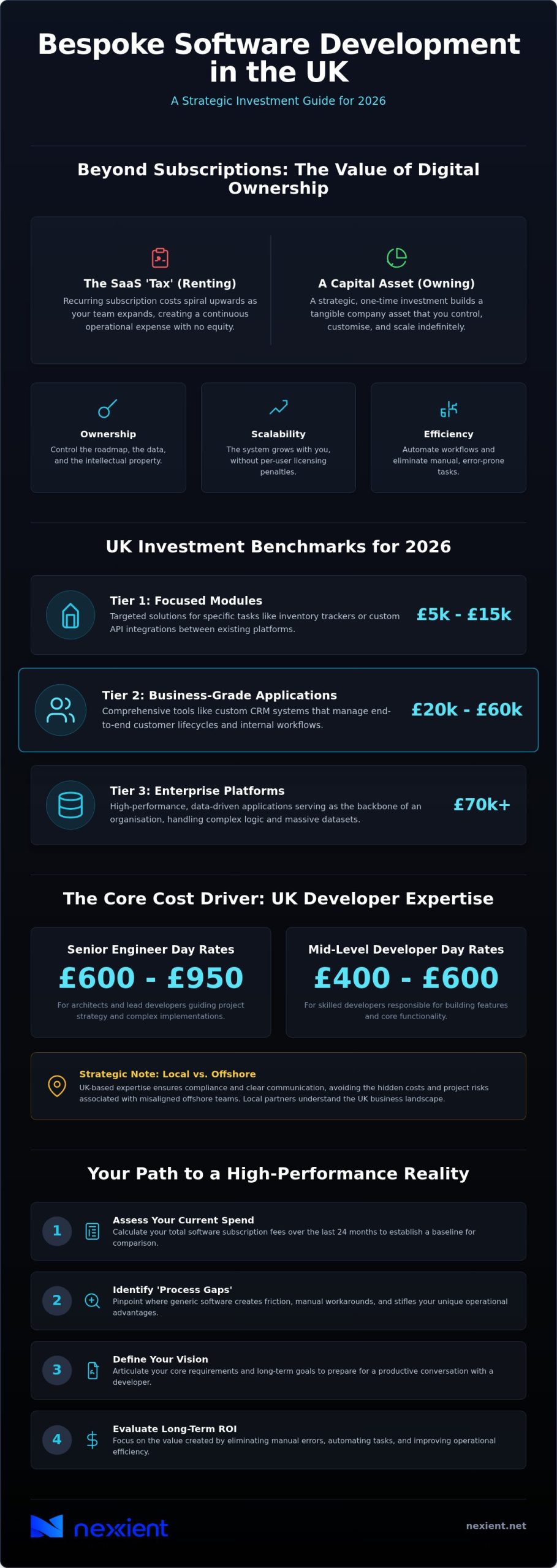
Bespoke software is a digital reflection of your business DNA. It is a solution architected from the ground up to align with your specific workflows, data structures, and user requirements. In 2026, the cost of bespoke software development UK is increasingly viewed as a capital investment rather than a recurring operational expense. This shift occurs because UK firms are moving away from the “workarounds” required by generic platforms that stifle their competitive edge. Custom software allows you to lead your industry rather than just keeping pace with it.
The value of this approach rests on three core pillars:
- Ownership: You control the roadmap, the data, and the intellectual property.
- Scalability: The system grows with you without per-user licensing penalties.
- Efficiency: Automated workflows eliminate the manual data entry that drains your team’s energy.
Ownership vs. Renting: The Long-Term Financial Shift
Many organisations are currently reconsidering the “SaaS Tax”. Whilst a monthly subscription for a handful of users seems affordable, these costs spiral as your team expands. For a business with 50 or more users, the cumulative fees over several years often dwarf the initial build costs of a private system. By investing in your own intellectual property, you secure the source code as a tangible company asset. Calculating the Total Cost of Ownership (TCO) over a five-year period usually reveals that owning your software is the more fiscally responsible path. It’s the difference between paying a mortgage and forever renting a property you aren’t allowed to renovate.
Solving the “Process Gap” with Custom Engineering
Off-the-shelf software often forces you to change how you work to fit the system’s limitations. This “process gap” erodes your unique secret sauce; the specific way you deliver value that competitors cannot easily replicate. Custom engineering bridges this gap. You can build, refine, and accelerate your operations with tools that mirror your internal logic perfectly. This synergy often starts with bespoke web design, providing the professional foundation for your broader digital presence. It’s about creating momentum, not managing compromises.
Strategic Action: To assess your current situation, calculate your total software subscription spend over the last 24 months. If those costs are rising whilst your operational efficiency remains stagnant, it is time to evaluate the long-term cost of bespoke software development UK versus your current model.
UK Price Benchmarks: What Does Custom Development Actually Cost?
The 2026 landscape of software engineering has shifted significantly. The integration of AI-assisted engineering tools has allowed developers to automate repetitive coding tasks, which has compressed production timelines and lowered entry prices for many firms. Even so, the cost of bespoke software development UK remains a reflection of the expertise and strategic planning required to build a reliable system. We utilise a “Visionary Architect” methodology that moves methodically through four stages: Discovery, Design, Development, and Deployment. This ensures every pound spent contributes directly to a functional business outcome.
The Three Tiers of Software Investment
While every project is unique, most requirements fall into three distinct financial categories based on their complexity and scale:
- Tier 1: Focused Modules (£5,000 – £15,000). These are targeted solutions designed for specific tasks, such as inventory trackers or custom API links between existing platforms.
- Tier 2: Business-Grade Applications (£20,000 – £60,000). This tier covers comprehensive tools like custom CRM systems that manage end-to-end customer lifecycles and internal workflows.
- Tier 3: Enterprise Platforms (£70,000+). These are high-performance, data-driven web applications that often serve as the backbone of an entire organisation, handling complex logic and massive datasets.
Day Rates and Regional Variations in the UK
Human expertise is the primary driver of your budget. In 2026, UK developer day rates for senior engineers typically range from £600 to £950, whilst mid-level developers command between £400 and £600. Geography plays a significant role here. London-based agencies often carry heavy overheads that inflate their quotes without necessarily increasing the quality of the output. Choosing a Worcestershire-based agency allows you to access high-level digital craftsmanship at a more sustainable price point.
Avoid the temptation of low-cost offshore alternatives. Whilst the initial hourly rate might look attractive, the hidden costs of communication barriers and misaligned standards often lead to project failure. Local expertise ensures your software complies with UK regulations and integrates seamlessly with your existing infrastructure. If you are ready to explore how these benchmarks apply to your vision, you can view our approach to data-driven tools to see what is possible.
Actionable Step: Before requesting a quote, categorise your project into one of the three tiers above. This helps you set a realistic budget and ensures you are talking to the right type of development partner for your specific needs.
Case Study: From Spreadsheet Chaos to Custom CRM Efficiency
Consider a West Midlands manufacturing firm managing high-value bespoke orders through a fragmented web of spreadsheets. This was the reality for one of our composite clients before they modernised their operations. They were losing over 20 hours every week to manual data entry and repetitive error correction. These inefficiencies didn’t just drain resources; they created a ceiling on how much the business could grow. Accuracy was slipping, and the team was burnt out by the sheer volume of clerical work.
To break through this barrier, they invested in a custom system tailored to their unique production line. The total cost of bespoke software development UK for this specific project was £35,000. This was not merely a purchase but a strategic capital allocation aimed at long-term operational stability. By moving away from manual tracking, they secured their data and prepared their business for a scalable future.
The Discovery Phase: Uncovering the Real Problem
We don’t begin by writing code. Instead, we start by identifying the specific bottleneck processes that generic, off-the-shelf tools often miss. By acting as a strategic website design company, we ensure the user interface is clean, functional, and intuitive for the workshop floor. Discovery is the strategic blueprint for all coding that ensures the software solves the right problems. This phase ensures the final product mirrors the staff’s mental model, which significantly reduces the time needed for onboarding and training.
The Implementation: Building for Growth
Our team utilised a phased rollout strategy to maintain business continuity. By launching a Minimum Viable Product (MVP), the firm saw immediate value and began recovering time within the first month. This allowed the workforce to adapt to the new digital tools without feeling overwhelmed by a sudden change. Many organisations start their digital journey with a simple brochure website, yet they eventually require a fully integrated engine to manage complex data. Transitioning from static pages to a dynamic business application is what drives sustainable momentum.
The final impact was transformative for the firm’s bottom line. They achieved an 85% reduction in admin time, allowing the office team to focus on business development rather than data fixing. Within 12 months, the project reached full ROI. The initial cost of bespoke software development UK was entirely offset by the recovered hours and the increased capacity to handle new orders.
Actionable Step: Identify your biggest time-sink. Track how many hours your team spends on manual data entry or spreadsheet management for one week. Use this data to calculate the potential annual savings a custom system could provide.
Navigating the Hidden Costs of Software Engineering
A transparent quote is the foundation of a successful partnership, yet the initial build is only the first chapter of your digital journey. To understand the true cost of bespoke software development UK, you must look beyond the launch date. Strategic budgeting involves accounting for the ecosystem that keeps your application performant, secure, and relevant. Ignoring these variables often leads to technical debt. This occurs when cutting corners during the initial build results in exponentially higher repair costs later. It’s far more efficient to invest in clean, modular architecture from the start to ensure your system remains a robust asset rather than a growing liability.
Ongoing Support and Evolution
Software is a living asset. It requires regular attention to remain compatible with evolving browser standards, operating system updates, and emerging security threats. Industry standards suggest setting aside approximately 15% to 20% of your initial development cost for annual maintenance. This budget covers essential security patches, minor feature iterations, and the general upkeep required to keep the code secure. Additionally, you should account for the cost of integrating with third-party APIs. Whether you’re linking to accounting platforms, shipping providers, or marketing tools, these external services often carry their own monthly fees and require occasional code adjustments to maintain a seamless connection.
Infrastructure and Scaling
The 2026 UK cloud landscape offers diverse hosting tiers tailored to your specific traffic requirements. A focused internal tool requires far less power than high-traffic e-commerce sites that must handle thousands of simultaneous transactions. Cloud hosting for UK SMEs typically ranges from £50 to over £3,000 per month depending on the scale and complexity of the data being processed. Security and compliance are also critical considerations. Adhering to GDPR and UK data regulations involves implementing robust encryption, regular penetration testing, and secure data migration protocols. Clean architecture reduces long-term hosting bills by ensuring your code utilises server resources with maximum efficiency.
Strategic Task: Audit your current digital ecosystem and list every third-party subscription your new software will need to talk to. If you want to build a system that scales without surprise expenses, explore our custom systems to see how we plan for the full lifecycle of your software.
Choosing the Right Partner: Local Expertise vs Global Agencies
The final decision in your digital transformation journey isn’t just about the numbers on a spreadsheet; it’s about the people who will build your vision. When evaluating the cost of bespoke software development UK, you will encounter three main types of partners: freelancers, large global agencies, and local boutique firms. Whilst freelancers offer lower entry points, they often lack the capacity for long-term support. Conversely, large global firms frequently carry high overheads that inflate your quote without adding proportional value to your specific project. A Worcestershire-based agency provides a strategic middle ground, offering high-level engineering expertise with the agility and personal dedication of a boutique partner.
It is vital to ensure you are investing in a truly unique solution. Many low-cost providers offer what is known as a “reskinned template,” which is a generic, pre-made system with a new coat of paint. These systems often fail to scale and eventually lead to the technical debt mentioned earlier. True bespoke development means every line of code is architected to serve your specific commercial objectives. To vet a partner effectively, look beyond their portfolio and ask about their strategic process. A reliable developer should act as a consultant who is as invested in your ROI as you are.
The Benefits of a UK-Based Partnership
Working with a partner in the West Midlands offers advantages that global agencies cannot replicate. Shared time zones and cultural alignment ensure that communication remains clear, consistent, and productive. There is a significant trust factor in being able to meet your “Visionary Architect” in person to discuss complex workflows. Local firms prefer partners they can rely on for face-to-face strategy sessions, ensuring the final product reflects the nuances of the UK market and its specific regulatory requirements.
Next Steps: How to Brief Your Project
To move from a vision to a functional system, you must prepare a clear brief. This process helps you secure a transparent, fixed-price quote and ensures your developer understands your priorities from day one. Follow these actionable steps to begin:
- Define your goals: Identify the three primary problems the software must solve.
- Organise your data: Map out where your information currently lives and where it needs to go.
- Centre your user needs: List the specific tasks your team needs to perform daily.
- Set your timeline: Determine your ideal launch date to help the agency plan resources.
Taking these steps allows you to approach the cost of bespoke software development UK with total clarity. Once your requirements are ready, you can visit our project enquiry page to start a conversation. We focus on providing the strategic benchmarks and technical precision required to transform your business operations into a high-performance digital asset.
Build Your Digital Vision with Confidence
Investing in custom technology is a vital strategy for any UK business aiming to secure a competitive edge. By choosing to own your intellectual property and eliminate recurring subscription fees, you transform an operational expense into a tangible company asset. Understanding the cost of bespoke software development UK allows you to budget with precision, ensuring that every pound invested drives measurable efficiency, long-term scalability, and commercial growth. We help you define, design, and deploy tools that move your business forward with purpose.
Success begins with a methodical approach to engineering. At Nexient, we combine our Worcestershire-based expertise with a commitment to transparency, providing fixed-price discovery phases that eliminate financial guesswork from the start. We specialise in building custom CRM systems and data-driven web applications that mirror your unique workflows perfectly. It’s time to move beyond the limitations of generic platforms and build a system that works as hard as you do. Transform your business with a bespoke software solution from Nexient and take the first step toward a more efficient, profitable future.
Frequently Asked Questions
How much does bespoke software cost in the UK in 2026?
Bespoke software investment in 2026 typically starts around £5,000 for focused modules and can exceed £70,000 for complex enterprise platforms. The final cost of bespoke software development UK depends on your specific functional requirements and data complexity. We use a methodical discovery phase to provide a transparent, fixed-price quote. This ensures your budget aligns with your vision from the start. Smaller business-grade applications often fall within the £20,000 to £60,000 range for a complete system.
Is bespoke software more expensive than off-the-shelf SaaS?
Custom software often has a higher upfront cost than off-the-shelf subscriptions, but it is frequently cheaper over a five-year period. You avoid the “SaaS tax” of monthly per-user fees that spiral as your team grows. Owning your source code also turns your software into a company asset rather than a recurring expense. Bespoke tools eliminate the need for expensive workarounds, allowing your business to operate with maximum efficiency and zero restrictive licensing fees.
How long does it take to develop a custom software application?
Development timelines typically range from three months for a focused Minimum Viable Product (MVP) to twelve months or more for enterprise-grade systems. The duration depends on the volume of unique features and the complexity of your existing data. We prioritise a phased rollout strategy, which allows you to launch core functionality early and see immediate value. This approach ensures your team can begin using the system whilst more advanced modules are still being engineered.
What are the main factors that drive up software development costs?
The primary drivers of cost are functional complexity, third-party integrations, and data migration requirements. Building a system that needs to talk to several external platforms or handle massive legacy datasets requires more engineering hours. Security standards and UK regulatory compliance also play a significant role. By focusing on clean architecture and essential features first, you can control these variables. It’s about building what you need today whilst preparing for the growth you expect tomorrow.
Can I build a custom system in phases to manage my budget?
Yes, building in phases is a highly effective way to manage your capital and reduce project risk. We recommend starting with a Minimum Viable Product (MVP) that solves your most urgent operational bottlenecks. This allows you to recover your investment through immediate efficiency gains before funding the next stage of development. You can then use real-world feedback from your team to refine the roadmap for future modules, ensuring every pound spent adds tangible value.
What happens if my business requirements change during development?
Change is managed through a collaborative, agile development process that allows for regular reviews and adjustments. Whilst our discovery phase creates a solid strategic blueprint, we understand that business needs can shift. We maintain a transparent dialogue to ensure any new requirements are balanced against your budget and timeline. This flexibility prevents scope creep and ensures the final product remains perfectly aligned with your commercial goals, even if your vision evolves during the build.
Are there ongoing costs after the software is built?
You should budget approximately 15% to 20% of the initial build cost annually for maintenance, security updates, and hosting. These ongoing expenses keep your code secure and ensure compatibility with evolving browser standards. You’ll also need to account for cloud hosting fees and any third-party API subscriptions your system relies on. Investing in regular upkeep protects your asset from technical debt and ensures the software continues to perform at its peak as your business scales.
Why should I choose a UK-based agency over offshore development?
Choosing a UK-based agency like Nexient ensures cultural alignment, shared time zones, and a deep understanding of local regulations. Working with a Worcestershire-based partner allows for face-to-face strategy sessions that build trust and clarity. Offshore development often suffers from communication barriers and hidden overheads that can derail complex projects. Local expertise ensures your software integrates seamlessly with UK-specific systems and complies with GDPR, providing a stable foundation for your long-term digital growth.